Miyagi: the cradle of four styles
Miyagi alone is home to four traditional styles, including the two best known: Naruko and Tōgatta.
Naruko (鳴子系)
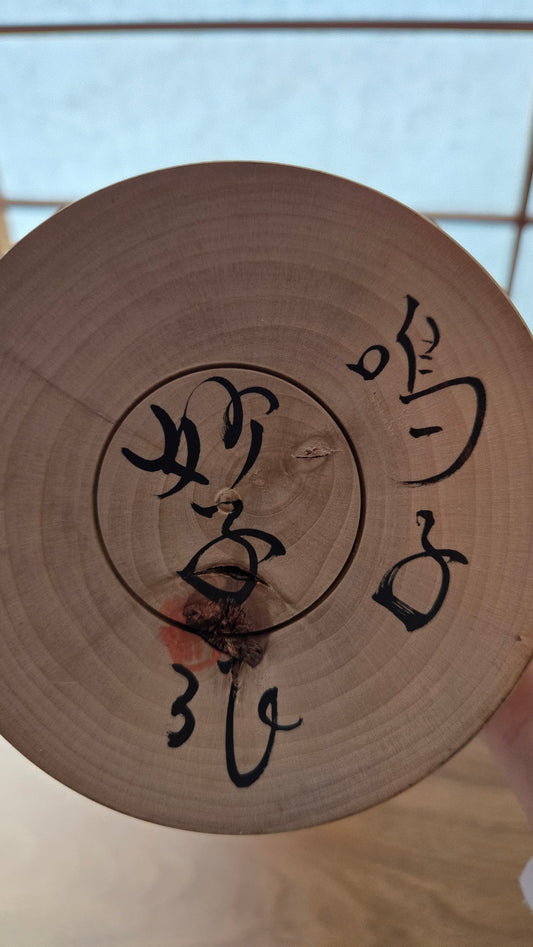
Originating from the Naruko hot spring town, this is the most recognisable style. Its head is fitted into the body and turns with a small, characteristic squeak. The body narrows in the middle, sometimes to the point of a concave shape, and is most often decorated with layered chrysanthemums (kasane-giku). From early on, Naruko kokeshi were made with a wider body so they could stand, as they were displayed alongside the dolls of the Girls' Day festival.
Tōgatta (遠刈田系)
Born in Tōgatta Onsen, at the foot of Mount Zaō, this style stands out for its large head decorated with red rays on top, extended by two red motifs shaped like the character « 八 » running from the forehead to the temples. These ornaments are called tegara (手絡), after the fabric used to adorn traditional Japanese chignons. The face is delicate, with elongated eyes. The straight, slender body bears hand-painted chrysanthemums or plum blossoms, and more rarely a wood-grain pattern.
Yajirō (弥治郎系)
Originating from the hamlet of Yajirō in Shiroishi, this style grew out of the observation of Tōgatta kokeshi. The top of the head is painted with multicoloured rings drawn on the lathe, like a beret. The body features wide coloured bands (rokuro-moyō) and a kimono collar or sleeves painted freehand.
Sakunami (作並系)
Born around Sakunami Onsen, near Sendai, this style also spread to the Yamagata side. The head has a red ring on top. The body, traditionally slim, shows a chrysanthemum framed between lathe-drawn bands. The slenderest pieces are sometimes given a small base to keep them from falling over.
Fukushima: Tsuchiyu and Nakanosawa
Fukushima is home to the Tsuchiyu style, one of the oldest, and its offshoot Nakanosawa, which became independent in 2018.
Tsuchiyu (土湯系)
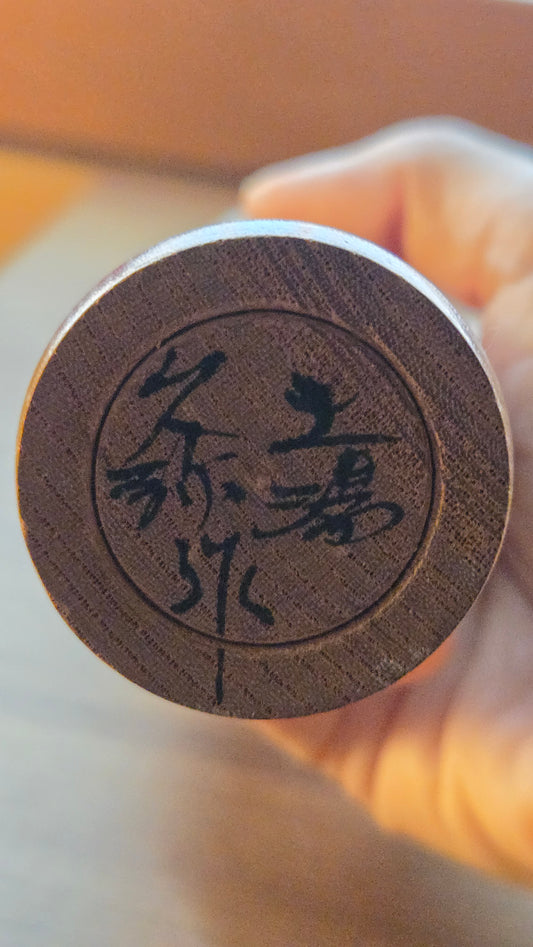
Originating from the Tsuchiyu, Iizaka and Dake hot springs, this style is recognisable by the concentric circles painted on top of the head, like a snake's eye (janome). Between the fringe and the side locks appears a red motif called kase. The body is mainly decorated with combined lines. Its technical signature: reversed stripes (kaeshi rokuro), created by changing the lathe's direction of rotation while the brush draws the line.
Nakanosawa (中ノ沢系)
Founded in Nakanosawa Onsen at the end of the Taishō era by Iwamoto Zenkichi, this style was long classified as a branch of Tsuchiyu. Its independence was approved in 2018, and the first Nakanosawa kokeshi festival was held in September 2022, marking 100 years of its emblematic figure nicknamed "tako bōzu". Kokeshi Wiki still classifies its artisans under the Tsuchiyu category.
Yamagata: Zaō Takayu, Yamagata and Hijiori
The three Yamagata styles are known for their generous floral decoration.
Zaō Takayu (蔵王高湯系)
Originating from Zaō Onsen, formerly known as Takayu, on the opposite side of Mount Zaō from Tōgatta. The head bears red radiating ornaments, though black bob haircuts are also found. The body features a wide variety of plants: chrysanthemums, cherry blossoms and many more.
Yamagata (山形系)
Born in the city of Yamagata, this style was long grouped with Sakunami before being counted separately. The head shows a fringe and locks on each side, with a red hair ornament. The body bears cherry blossoms, four-petalled plum blossoms and lathe-drawn bands.
Hijiori (肘折系)
Born in Hijiori Onsen as an offshoot of the Tōgatta and Naruko styles, this is one of the most distinctive styles. Its vivid colours recall oil painting, and its faces are full of character. It is recognisable by its bright yellow body decorated with upright chrysanthemums, its black bob and its large hair ornaments. Some pieces have crescent-moon eyes that give them a peaceful expression.
Akita, Iwate and Aomori: Kijiyama, Nanbu and Tsugaru
The north of Tōhoku gave rise to three very different styles, from the most understated to the most festive.
Kijiyama (木地山系)
Originating from the village of Kijiyama in Akita, this style takes its name from the kijiya, the wood-turning artisans who lived there. The head features a large fringe and side locks, with a red radiating ornament. The eyes are often half-closed or closed. The most famous decoration is the apron worn over the kimono (maedare), but there is also an older style decorated only with chrysanthemums, as well as striped kimonos and plum blossoms associated with the Ogura family. The head and body are often carved from a single piece of wood.
Nanbu (南部系)
Originating from Morioka and Hanamaki Onsen in Iwate Prefecture, this style descends from the kinakina, an unpainted teething toy for babies. Its head is not fixed: it wobbles and makes a small sound when shaken. Long left bare to show off the wood grain, the body is nowadays sometimes given a simple decoration.
Tsugaru (津軽系)
Originating from Nuruyu Onsen and Ōwani Onsen in Aomori Prefecture, this style is also known as Nuruyu. The body features lathe-drawn bands, a sash, flowers, and above all motifs inspired by the lanterns of the Nebuta festival. Peonies, daruma or the crest of the Tsugaru clan are also found, with a silhouette featuring a narrow waist and flared skirt.